
-
admin
- September 9, 2026
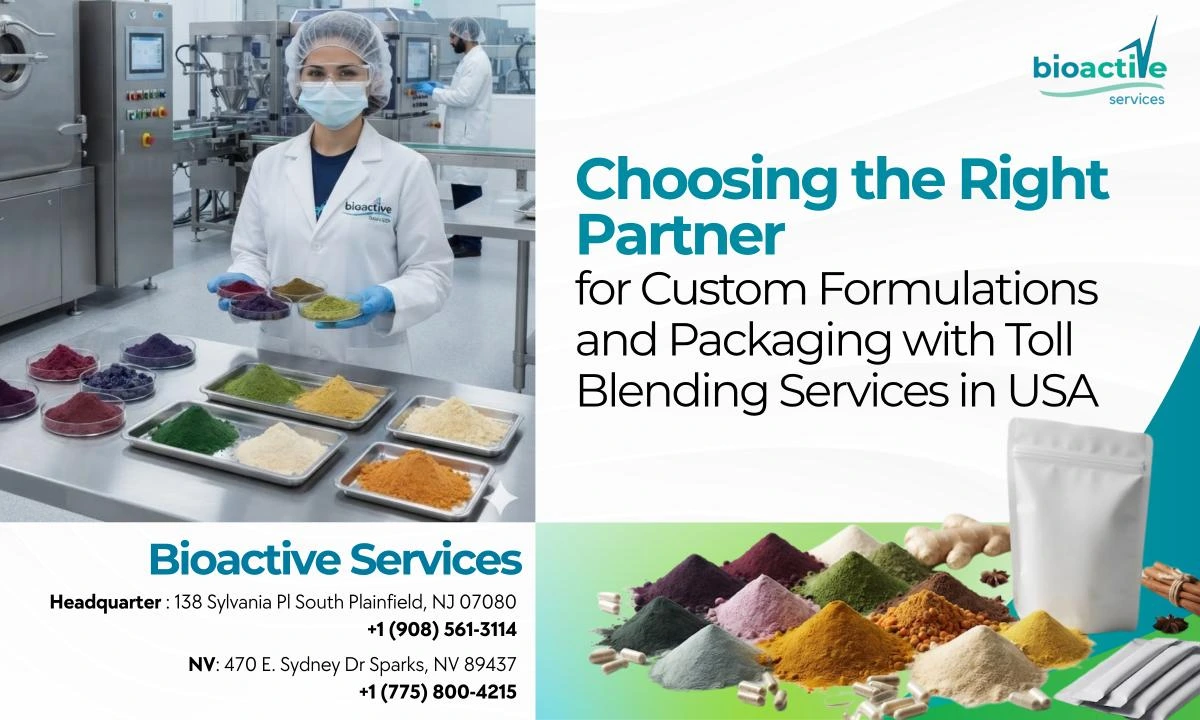
Choosing the Right Partner for Custom Formulations and Packaging with Toll Blending Services in USA
Developing a successful powdered food, nutraceutical, botanical, or dietary supplement product requires more than a good formulation. Manufacturers also need reliable blending, microbial control, quality assurance, packaging, and documentation to move efficiently from raw ingredients to a market-ready product.
For this reason, choosing the right partner for Custom Formulations and Packaging can have a significant impact on product quality, production efficiency, scalability, and time to market.
Instead of coordinating separate companies for formulation, sterilization, toll blending, testing, and packaging, brands can work with an integrated processing partner that manages multiple stages within one controlled workflow.
For companies searching for Toll Blending Services in USA, the ideal partner should combine technical expertise with dependable quality systems, flexible production capabilities, food safety controls, and packaging support.
Why Choosing the Right Powder Processing Partner Matters
A manufacturing partner becomes an extension of your product development and supply chain operations.
The wrong partner can create problems such as inconsistent blends, production delays, excessive ingredient handling, limited scalability, or incomplete documentation. The right partner can simplify the process from product concept through finished packaging.
Reducing Supply Chain Complexity
Using separate suppliers for formulation, microbial reduction, blending, and packaging can create additional transportation and scheduling requirements.
An integrated provider can coordinate multiple production stages, reducing unnecessary transfers and improving visibility across the manufacturing process.
Improving Product Consistency
Powdered products often contain ingredients with different particle sizes, densities, moisture levels, and flow characteristics.
Experienced toll blenders understand these variables and select appropriate processing methods to achieve consistent ingredient distribution.
Supporting Faster Time to Market
When formulation, blending, testing, and packaging are coordinated through one manufacturing relationship, brands can reduce unnecessary handoffs and streamline product development.
What Are Custom Formulations and Packaging Services?
Custom Formulations and Packaging combine product development with manufacturing and final product preparation.
A capable partner can help transform individual ingredients into a finished powdered product according to defined specifications.
Services may include:
- Ingredient evaluation
- Formula development
- Prototype and pilot batches
- Powder blending
- Microbial reduction
- Quality testing
- Bulk packaging
- Retail packaging
- Private label preparation
This integrated model is particularly valuable for brands developing complex nutraceutical, botanical, functional food, and clean-label products.
Custom Powder Formulation
Formulation begins with understanding the intended application and product specifications.
Depending on the product, formulation considerations may include:
- Ingredient compatibility
- Dosage requirements
- Flavor
- Solubility
- Flowability
- Moisture sensitivity
- Processing stability
- Finished-product specifications
A strong formulation partner should understand both the science of the ingredients and the realities of commercial-scale powder manufacturing.
Toll Blending
Toll blending allows brands to outsource powder mixing to an experienced manufacturing company.
Modern blending systems can process a wide range of powdered ingredients, including:
- Herbs
- Spices
- Botanical powders
- Nutraceutical ingredients
- Functional food ingredients
- Plant-based powders
The objective is a homogeneous blend that meets established specifications from batch to batch.
What to Look for in Toll Blending Services in USA
Not every toll blender offers the same capabilities. Before selecting a provider, evaluate several factors.
Powder Blending Equipment and Expertise
Ask what types of blending equipment are available and whether the processor has experience with ingredients similar to yours.
Equipment selection can influence:
- Blend uniformity
- Processing time
- Shear exposure
- Product handling
- Batch capacity
Batch Consistency and Blend Uniformity
A reliable provider should have documented procedures for controlling blend uniformity and identifying potential segregation issues.
Consistency is particularly important when formulations contain low-dose active ingredients that must be evenly distributed throughout the finished powder.
Production Capacity and Scalability
Your manufacturing partner should be able to support your expected production requirements and ideally provide a path from development quantities to commercial-scale batches.
Ask about:
- Minimum batch sizes
- Commercial capacity
- Production scheduling
- Lead times
- Scale-up procedures
Why Integrate Steam Sterilization into Powder Processing?
Raw agricultural ingredients can carry microorganisms from cultivation, harvesting, drying, transportation, and storage.
For appropriate ingredients and applications, validated steam processing can be incorporated into the manufacturing workflow as a microbial reduction step.
Steam Sterilization Services in USA may be particularly relevant to manufacturers working with herbs, spices, botanicals, and powdered ingredients where microbial specifications are critical.
Steam Sterilization for Herbs and Spices
Herbs and spices are agricultural products that may require microbial control before they are incorporated into a finished blend.
An appropriate steam treatment can reduce microbial loads while avoiding chemical fumigation.
Processing conditions must be established and validated for the specific ingredient and target microbial requirements.
Steam Sterilization for Nutraceuticals
Nutraceutical powders and botanical ingredients may also require microbial reduction before formulation or blending.
Because heat and moisture can affect different ingredients differently, processors should evaluate the stability and characteristics of the specific material before establishing processing parameters.
Organic Powdered Steam Sterilization
For clean-label and organic brands, Organic Powdered Steam Sterilization can provide a processing option based on controlled steam rather than chemical fumigation.
The appropriate processing method depends on the ingredient, certification requirements, product specifications, and validated process parameters.
Evaluating Microbial Reduction and Food Safety Capabilities
Food safety should be an important part of your partner-selection process.
Companies searching for Food Sterilization Service Providers in the USA should evaluate whether a prospective partner can provide appropriate process validation, microbial testing, documentation, and quality controls.
5-Log Microbial Reduction
A 5-log reduction corresponds to a 99.999% reduction in the targeted microbial population.
However, a 5-log claim should not simply be treated as a generic marketing statement. The required reduction, target organism, processing conditions, and validation methodology should be established for the specific application.
Process Validation and Verification
Ask prospective partners how they establish and verify microbial reduction.
Documentation may include:
- Validation studies
- Processing parameters
- Laboratory results
- Batch records
- Monitoring procedures
- Corrective-action procedures
Microbial Testing and Documentation
A robust food safety program may include testing of incoming materials, in-process samples, and finished products according to the product’s specifications and food safety plan.
This documentation can be valuable when qualifying suppliers, supporting audits, and demonstrating manufacturing controls.
Regulatory Compliance and Quality Assurance
Your manufacturing partner should understand the regulatory environment applicable to your product and provide documentation that supports your quality program.
Relevant systems may include:
- FDA requirements
- FSMA preventive controls
- cGMP practices
- HACCP-based food safety programs
- Supplier qualification
- Lot traceability
- Product specifications
The exact requirements depend on the product category, intended use, facility, and applicable regulations.
Traceability and Batch Documentation
Traceability is especially important when multiple ingredients are combined into a finished formulation.
A strong manufacturing system should allow the production team to track relevant information such as:
- Ingredient lots
- Processing dates
- Batch numbers
- Processing parameters
- Testing results
- Packaging information
Good documentation improves supply chain visibility and supports effective quality investigations when needed.
Packaging Options for Powdered Ingredients
After formulation, blending, sterilization, and testing, packaging protects the finished product from environmental exposure and facilitates distribution.
Bulk Packaging
Bulk formats may include:
- Fiber drums
- Bulk bags
- Super sacks
- Totes
These formats can be appropriate for ingredient suppliers and manufacturers purchasing powders for further processing.
Retail-Ready Packaging
Consumer products may require:
- Pouches
- Jars
- Canisters
- Sachets
- Stick packs
Packaging should be selected according to product characteristics, shelf-life requirements, distribution conditions, and brand specifications.
Custom and Private Label Packaging
For emerging brands, an integrated packaging service can simplify the transition from formulation to finished retail product.
Depending on the provider, services may include filling, labeling, and other finished-product preparation.
Questions to Ask Before Selecting a Manufacturing Partner
Before signing with a toll blender or contract processor, ask:
Technical Capabilities
- Do you specialize in powdered ingredients?
- What blending technologies do you use?
- Can you handle herbs, spices, botanicals, and nutraceutical ingredients?
- Can you support custom formulation?
Food Safety
- Do you offer steam sterilization?
- How do you validate microbial reduction?
- Can you support a 5-log reduction requirement when applicable?
- What microbial testing is available?
Quality and Compliance
- What quality systems are maintained?
- How are batches documented?
- How is ingredient traceability managed?
- Can you provide certificates and test documentation?
Production and Scalability
- What are your minimum batch sizes?
- Can you support pilot and commercial production?
- What packaging formats are available?
- How are production schedules managed?
The answers can help distinguish a true end-to-end manufacturing partner from a provider offering only one stage of processing.
Who Benefits from Integrated Formulation, Toll Blending, and Packaging?
Integrated processing can benefit a wide range of manufacturers.
Nutraceutical and Dietary Supplement Brands
Companies developing powdered supplements can combine formulation, blending, microbial control, testing, and packaging.
Herb, Spice, and Botanical Companies
Processors working with agricultural powders can incorporate microbial reduction into their broader production workflow.
Functional Food and Clean-Label Brands
Brands developing clean-label powdered products can benefit from coordinated formulation, blending, packaging, and quality management.
Why Bioactive Services for End-to-End Powder Processing?
For companies looking for an integrated manufacturing relationship, Bioactive Services can be positioned around the complete powder-processing workflow.
The value of an end-to-end partner is not simply the ability to perform individual services. It is the ability to coordinate formulation, toll blending, microbial reduction, quality controls, and packaging around the specifications of the finished product.
This model can help brands reduce supply chain complexity while maintaining greater control over product consistency and manufacturing requirements.
For companies evaluating Custom Formulations and Packaging alongside Toll Blending Services in USA, selecting a partner with complementary powder-processing capabilities can create a more efficient path from raw ingredients to market-ready products.
Frequently Asked Questions
What should I look for in a toll blending partner in the USA?
Look for powder-processing expertise, appropriate blending equipment, documented quality systems, scalable production capacity, strong traceability, food safety capabilities, and packaging support.
Can toll blending companies also provide custom formulation?
Some integrated processors offer both formulation development and toll blending. Confirm the provider’s specific formulation capabilities and experience with your ingredient category.
Why combine formulation, toll blending, and packaging?
Combining these services can reduce supplier coordination, unnecessary ingredient transfers, scheduling complexity, and overall supply chain friction.
Can steam sterilization be used for herbs and spices?
Steam processing can be used for appropriate herbs and spices as part of a validated microbial reduction process. Processing conditions should be established according to the specific ingredient and food safety objective.
What does a 5-log microbial reduction mean?
A 5-log reduction means reducing a targeted microbial population by 99.999%. The applicable target organism and validation requirements depend on the specific food safety process.
Is steam sterilization suitable for organic powdered ingredients?
Steam processing may be suitable for certain organic powdered ingredients, subject to the ingredient’s characteristics, processing requirements, and applicable organic certification standards.
What packaging options are available for powdered products?
Depending on the provider, options can include bulk bags, drums, pouches, jars, canisters, sachets, and stick packs.
How do I choose between multiple toll blending providers?
Compare their technical capabilities, quality systems, food safety validation, production capacity, scalability, packaging options, documentation, and experience with similar ingredients and products.