
-
admin
- October 19, 2026
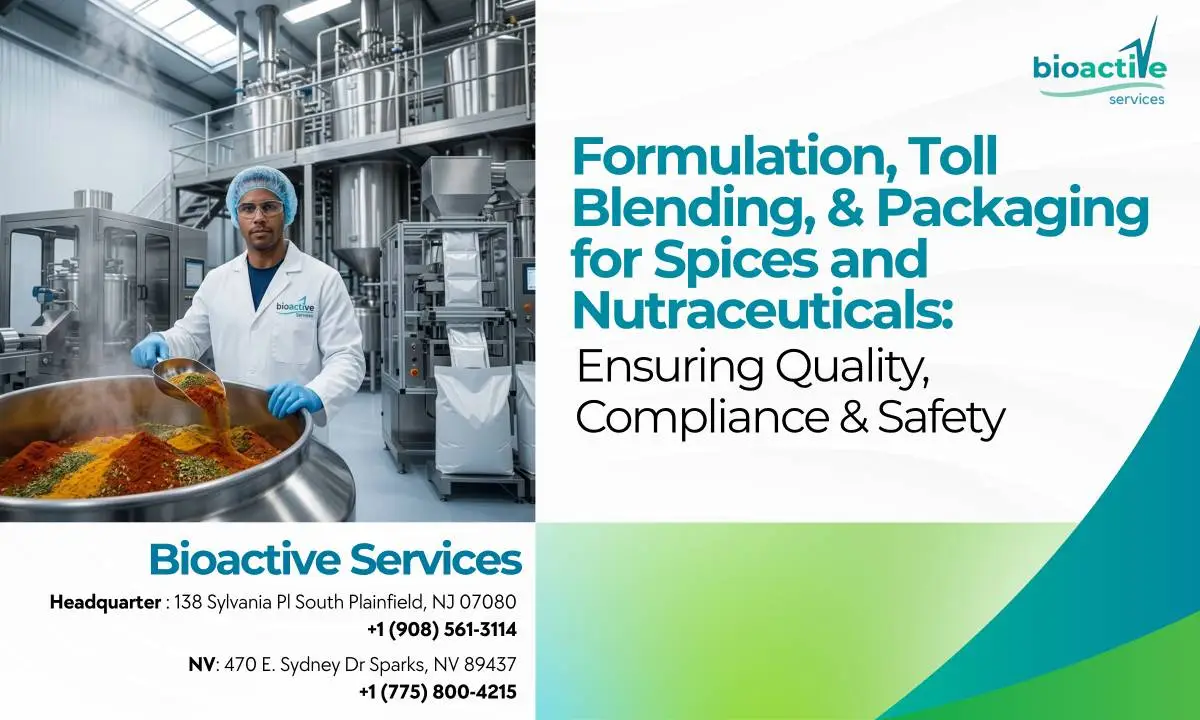
Formulation, Toll Blending, & Packaging for Spices and Nutraceuticals: Ensuring Quality, Compliance & Safety
Spices and nutraceutical ingredients play an important role in food manufacturing, dietary supplements, functional nutrition, and wellness products. However, transforming raw powdered ingredients into consistent, safe, market-ready products requires more than simply combining materials and filling packages. Manufacturers must manage ingredient variability, microbial risks, formulation accuracy, production efficiency, packaging integrity, and applicable regulatory requirements.
Integrated formulation, toll blending, and packaging services help businesses coordinate these essential processes under a more streamlined production strategy. By connecting product development with controlled blending, appropriate microbial reduction measures, and suitable packaging, brands can improve consistency while preparing for commercial production.
For companies working with herbs, spices, botanical powders, plant extracts, and nutraceutical blends, selecting the right processing partner can make a meaningful difference in product quality and supply chain reliability.
Understanding Formulation, Toll Blending, and Packaging
Formulation, toll blending, and packaging are related but distinct stages of powder product development and manufacturing. When planned together, they help reduce production complexity and improve coordination between ingredient specifications, processing requirements, and finished-product expectations.
Custom Formulation for Spices and Nutraceuticals
Formulation establishes the composition and target characteristics of a finished product. It involves selecting ingredients, defining proportions, evaluating compatibility, and determining the specifications needed for consistent manufacturing.
For spice products, formulation may focus on flavor balance, aroma, color, heat level, flowability, and performance in the intended food application. For nutraceutical powders, priorities may include ingredient uniformity, serving-size accuracy, dispersibility, sensory characteristics, and the stability of selected active ingredients.
A well-developed formulation should consider:
- Ingredient identity, purity, and quality specifications.
- Particle size and density differences.
- Moisture sensitivity and storage requirements.
- Potential interactions between ingredients.
- Allergen and cross-contact considerations.
- Intended product use and applicable regulatory requirements.
- Processing conditions and packaging compatibility.
Formulation decisions should also account for how a blend will behave during manufacturing. A recipe that performs well in a small laboratory sample may require adjustments before it can be blended consistently at commercial scale.
Toll Blending for Consistent Powder Quality
Toll blending allows a company to use a third-party processor to combine ingredients according to agreed specifications. Rather than investing in all the equipment, labor, and infrastructure required for in-house production, a brand can work with a specialized provider whose capabilities match its project requirements.
For spices, toll blending may involve combining individual spices, herbs, flavoring ingredients, or functional components into a uniform mixture. Nutraceutical applications may include botanical blends, powdered supplement ingredients, and other dry formulations.
An effective toll blending program typically considers:
- Batch size and production scheduling.
- Ingredient receiving and identification.
- Blending sequence and processing parameters.
- Equipment suitability and cleaning procedures.
- Blend uniformity and sampling plans.
- Batch documentation and traceability.
- Material handling and loss prevention.
The goal is to produce a blend that meets defined specifications from batch to batch. Appropriate sampling and testing are important because a visually uniform powder does not automatically guarantee that every component is evenly distributed.
Packaging for Product Protection and Distribution
Packaging is the final operational stage before products enter storage, distribution, or retail channels. It protects the blend from environmental exposure and helps preserve the characteristics established during formulation and processing.
Depending on the product, packaging options may include pouches, bags, tubs, jars, bulk liners, or other food-contact-compatible formats. The appropriate choice depends on factors such as powder flow, package size, storage conditions, transportation requirements, and the intended customer.
Packaging decisions should consider:
- Moisture and oxygen barrier performance.
- Protection against contamination during filling and sealing.
- Package strength and seal integrity.
- Compatibility with the product.
- Storage and transportation conditions.
- Labeling and lot identification.
- Retail, foodservice, or industrial handling needs.
Integrating packaging planning into formulation and toll blending helps businesses identify potential problems earlier, such as powders that bridge during filling, absorb moisture easily, or require additional protection during storage.
Why Quality Control Matters for Spices and Nutraceuticals
Quality control is essential because powdered ingredients can vary significantly in composition, physical properties, and microbiological condition. Raw materials may be affected by agricultural conditions, harvesting, drying, transportation, storage, and upstream processing.
Even ingredients with low moisture content can carry microorganisms. Many pathogens cannot grow readily in sufficiently dry products, but they may survive for extended periods. This makes preventive controls and appropriate ingredient treatment important for products intended for food or supplement applications.
Managing Ingredient Variability
Spices, herbs, and botanical materials are naturally variable. Their flavor, aroma, color, moisture, particle size, and chemical composition may differ by crop, origin, harvest, and supplier.
A robust quality program starts with defined incoming-material specifications. Depending on the ingredient and its intended use, evaluations may include identity testing, physical inspection, moisture measurement, contaminant screening, and microbiological testing.
Manufacturers should also establish procedures for handling materials that fail specifications. Clear acceptance criteria, documented deviations, and supplier qualification practices help prevent unsuitable ingredients from entering production.
Achieving Consistent Blend Uniformity
Blend uniformity is particularly important when a product contains ingredients at substantially different inclusion rates. Small quantities of potent botanical ingredients, vitamins, minerals, flavor components, or other functional materials may be difficult to distribute consistently throughout a large batch.
The blending process should be designed around ingredient characteristics, batch size, equipment geometry, and the required level of uniformity.
Useful controls may include:
- Standardized ingredient weighing procedures.
- Defined addition sequences.
- Validated or otherwise appropriately qualified blending parameters.
- Representative sampling at suitable locations.
- Testing against product-specific acceptance criteria.
- Documented batch records and review procedures.
These practices support repeatability and help manufacturers investigate unexpected results before releasing finished products.
Microbial Safety and Steam Sterilization Considerations
Microbial control can be a critical part of manufacturing spices, herbs, and nutraceutical powders. The appropriate strategy depends on the material, the microorganisms of concern, the product’s intended use, customer specifications, and applicable requirements.
Steam-based processing may be considered for certain powdered ingredients because it uses heat and moisture to reduce microbial populations. However, it must be evaluated for the specific material and process conditions rather than assumed to deliver the same result for every ingredient.
How Steam Treatment Can Support Powder Safety
Steam treatment exposes ingredients to controlled thermal and moisture conditions designed to achieve a defined microbial reduction. Depending on the process and material, this treatment may help reduce relevant microbial hazards before the ingredients are blended or packaged.
A successful process must account for several variables, including:
- The target microorganism and its resistance.
- Initial microbial levels and ingredient condition.
- Product composition, particle characteristics, and moisture.
- Time, temperature, and moisture exposure.
- Equipment performance and process uniformity.
- Potential effects on aroma, color, texture, and sensitive compounds.
- Post-treatment handling and the risk of recontamination.
Not every ingredient is suitable for the same steam treatment. Spices rich in volatile aromatic compounds and nutraceutical ingredients containing heat-sensitive constituents may require particular attention to product quality.
Understanding 5-Log Microbial Reduction
A 5-log reduction represents a 100,000-fold decrease in the number of viable target microorganisms, equivalent to a 99.999% reduction from the starting population under the defined test conditions.
For example, a reduction from 100,000 viable target organisms to an expected level of one represents a 5-log reduction. Actual results depend on the starting level, sampling method, analytical detection limits, and performance of the treatment.
A 5-log reduction should not be treated as a universal guarantee of product safety or as an automatic result of steam processing. It must be demonstrated through a scientifically appropriate validation approach for the target organism, ingredient, and process.
Validation and verification activities may include process studies, documented operating limits, microbiological testing, and ongoing monitoring. The exact approach should reflect the product’s hazard analysis and applicable regulatory or customer requirements.
Preventing Recontamination After Treatment
Microbial reduction during processing is only one part of a broader food safety strategy. Treated ingredients can be recontaminated if exposed to contaminated equipment, personnel, air, contact surfaces, or untreated materials.
Facilities should establish suitable separation between untreated and treated materials where necessary, maintain effective sanitation procedures, control personnel and material movement, and protect treated ingredients during blending and packaging.
For brands evaluating Steam Sterilization Services in USA, it is important to ask how a provider validates its process, documents results, manages post-treatment handling, and evaluates any effects on ingredient quality.
Regulatory Compliance for Spice and Nutraceutical Products
Compliance requirements depend on the product category, intended use, manufacturing activities, and markets where the product will be sold. Spices used as conventional food ingredients and powders marketed as dietary supplements may be subject to different regulatory frameworks.
Businesses should confirm which requirements apply to their specific products instead of assuming that one standard covers every application.
Food Safety and Manufacturing Controls
For relevant food facilities in the United States, applicable requirements may include current good manufacturing practice, hazard analysis, preventive controls, supplier controls, sanitation, and recordkeeping under the appropriate regulatory framework.
Dietary supplement manufacturing may also involve specific requirements for identity, purity, strength, composition, and limits on contaminants. Applicability depends on the product and the activities being performed.
A toll blending or packaging partner should be able to explain its quality systems, facility practices, documentation capabilities, and the scope of any certifications or registrations it holds. Brands should independently verify that these arrangements satisfy their obligations as product owners.
Documentation and Traceability
Traceability helps businesses connect incoming ingredients with production batches and finished products. It also supports investigations, complaints, corrective actions, and recalls when needed.
Useful records may include:
- Supplier and ingredient identification.
- Certificates of analysis, where applicable.
- Incoming inspection and acceptance records.
- Batch formulas and weighing records.
- Blending and processing parameters.
- Microbiological testing and validation documentation.
- Packaging and lot-code records.
- Release decisions and deviation reports.
Clear documentation helps manufacturers demonstrate control over their processes and gives customers greater confidence in the finished product.
Organic and Clean-Label Requirements
Brands that market organic products must ensure that ingredients, processing activities, handling, and labeling meet the requirements applicable to the product and its certification scope.
Steam processing does not automatically make an ingredient organic, and a facility’s organic certification should not be assumed to cover every ingredient or service it handles. Businesses should confirm the certification status of the relevant facility, process, and product before making organic claims.
Clean-label positioning also requires care. Terms such as “natural,” “clean label,” or “free from” should be supported by the actual formulation, processing aids, ingredients, and applicable labeling rules.
Improving Production Efficiency Through Integrated Services
Working with separate providers for formulation, blending, microbial treatment, and packaging can create additional transportation, scheduling, documentation, and coordination requirements. An integrated approach may help reduce these challenges when the provider has the appropriate capabilities and quality systems.
Streamlining the Production Workflow
A coordinated production plan can connect ingredient specifications with formulation development, blending requirements, any necessary microbial treatment, and final packaging.
For example, a brand launching a botanical powder blend may need to determine which ingredients require treatment, how the treatment affects sensory quality, how the components should be blended, and which packaging format best protects the finished product.
Planning these decisions together can help identify compatibility issues earlier and reduce unnecessary rework.
Supporting Scalable Manufacturing
Scaling a product from pilot batches to larger production volumes requires more than increasing the quantity of each ingredient. Equipment performance, blending behavior, processing time, material handling, and filling accuracy may change as batch size increases.
A capable manufacturing partner should work with the brand to establish suitable production parameters, confirm product specifications, and assess whether the process remains consistent as volume grows.
Toll blending can also help companies manage changing demand without immediately investing in dedicated blending equipment and packaging lines. However, businesses should evaluate minimum batch sizes, scheduling flexibility, capacity, lead times, and contingency arrangements before choosing a provider.
Reducing Operational Complexity
Coordinated services can simplify communication by establishing clearer responsibilities for ingredient handling, production scheduling, testing, documentation, and packaging specifications.
Potential benefits include fewer handoffs, better production planning, and more consistent records. These benefits are not automatic; they depend on the provider’s capabilities, process integration, and communication practices.
Brands should define responsibilities in writing, including who approves formulations, who arranges testing, how deviations are managed, and which party authorizes finished-product release.
Choosing a Formulation, Toll Blending, and Packaging Partner
The right partner should offer a suitable combination of technical expertise, quality controls, processing capabilities, and transparent communication. Price is important, but the lowest quoted cost may not reflect the total cost of testing, handling, shipping, rework, and quality management.
Evaluate Technical Capabilities
Ask whether the provider has experience with the relevant ingredient types, powder characteristics, and production volumes. A spice blend, a hygroscopic botanical powder, and a nutraceutical formulation with low-inclusion ingredients may require different processing approaches.
Discuss formulation support, blending equipment, packaging options, material segregation, and any required microbial treatment. Confirm the actual scope of services instead of relying on broad descriptions.
Review Quality Systems and Validation Practices
Request information about incoming-material controls, sanitation, batch documentation, traceability, testing arrangements, deviation management, and finished-product release.
If microbial reduction is required, ask what organism or hazard the process addresses, how the process was validated, which product conditions were studied, and how routine performance is monitored. A general statement that a facility offers sterilization is not a substitute for evidence that the treatment is appropriate for the intended ingredient.
Confirm Packaging and Supply Chain Compatibility
Packaging should match the product’s physical characteristics, storage needs, distribution environment, and customer requirements. Confirm package sizes, barrier properties, seal controls, lot coding, and any specialized filling or labeling needs.
Also review lead times, minimum order quantities, raw material sourcing responsibilities, inventory policies, and procedures for handling supply disruptions.
Ask the Right Questions Before Production
Before entering a manufacturing agreement, consider asking:
- Which services are performed in-house and which are outsourced?
- What specifications and acceptance criteria will govern each batch?
- How are blending uniformity and ingredient identity evaluated?
- What microbial treatment options are available, and what validation supports them?
- How are treated ingredients protected from recontamination?
- What quality records and traceability information will be provided?
- How are formulation changes and production deviations approved?
- Which certifications apply to the facility, process, or product?
- How are packaging specifications and finished-product release managed?
Documenting the answers helps establish realistic expectations and supports a stronger working relationship.
Applications Across Spice and Nutraceutical Markets
Integrated formulation, toll blending, and packaging services can support a range of powder products, provided the chosen processes are appropriate for the ingredients and intended applications.
Spices, Seasonings, and Botanical Ingredients
Spice manufacturers may use custom blending to create seasoning mixes, culinary blends, herb combinations, and ingredient systems for commercial food production. Key priorities include consistent flavor, aroma, color, particle distribution, and microbial quality.
When treatment is required, the process should be evaluated for both safety and its effect on sensory properties. Some aromatic ingredients may be particularly sensitive to heat and moisture.
Nutraceutical and Functional Powders
Nutraceutical applications may include botanical blends, plant-based powders, functional ingredient combinations, and powdered supplement formulations. Important considerations include ingredient identity, blend uniformity, moisture control, serving-size consistency, and compatibility with the intended package.
Depending on the formulation, manufacturers may also need to assess stability, dispersibility, taste, and the effect of processing on sensitive constituents.
Private-Label and Emerging Brands
Smaller and growing brands may benefit from access to contract processing without building a complete manufacturing operation. A qualified partner can help coordinate the production stages required for a market-ready product.
Before launching, brands should ensure that product claims, ingredient declarations, packaging, and required documentation are accurate and appropriate for the market where the product will be sold.
Frequently Asked Questions
What are formulation, toll blending, and packaging services?
These services cover the development of a product formula, the controlled mixing of ingredients according to defined specifications, and the filling and packaging of the finished blend. When coordinated, they can help businesses manage production more efficiently.
Why is toll blending important for spices and nutraceuticals?
Toll blending gives businesses access to specialized processing equipment and production expertise without requiring them to own and operate every part of the manufacturing process. It can support consistent batches, flexible production volumes, and more efficient use of internal resources.
Can steam sterilization achieve a 5-log microbial reduction?
It may be possible under validated conditions, but results depend on the target microorganism, ingredient properties, initial contamination, equipment, and processing parameters. A 5-log reduction must be supported by appropriate validation evidence; it should not be assumed for every ingredient or steam treatment.
Are steam-treated powdered ingredients automatically safe?
No. A treatment may reduce specific microorganisms, but overall safety also depends on ingredient sourcing, hazard controls, handling, post-treatment protection, storage, and intended use. Recontamination remains a concern if the process is not managed appropriately.
Can organic spices and nutraceutical powders undergo steam treatment?
Potentially, but the suitability of the process and its effect on ingredient quality must be evaluated. Businesses should also confirm that the applicable organic certification and handling requirements cover the ingredient and processing activities involved.
What should brands look for in a toll blending and packaging provider?
Brands should assess relevant ingredient experience, blending capabilities, quality systems, traceability, testing and validation practices, packaging options, production capacity, and communication. Providers should clearly explain which services they perform and what documentation they can supply.
How does integrated processing improve production efficiency?
Coordinating formulation, blending, treatment where required, and packaging can reduce handoffs and make production planning easier. The actual benefits depend on the provider’s capabilities, scheduling, quality controls, and ability to manage the complete workflow.
What information should be prepared before requesting a quote?
Useful information includes the ingredient list, target formula or formulation objectives, expected batch size, product specifications, required testing, microbial treatment needs, package type and size, estimated annual volume, and intended market. Sharing these details helps a provider assess feasibility and prepare a more accurate proposal.
Conclusion: Building Better Powder Products Through Integrated Processing
Producing high-quality spice and nutraceutical powders requires coordinated decisions about formulation, ingredient handling, blending, microbial risk management, documentation, and packaging. Each stage contributes to the consistency and suitability of the finished product.
By choosing an appropriate formulation, toll blending, and packaging partner, brands can access specialized processing resources, improve production coordination, and establish clearer quality expectations. Microbial treatment, including steam-based processing where suitable, should be supported by product-specific evaluation and validation rather than assumptions about universal performance.
Bioactive Services is a resource for businesses exploring powder ingredient processing and integrated production solutions. Visit Bioactive Services to learn more about its services and discuss your formulation, toll blending, packaging, and ingredient-processing requirements.