
-
admin
- September 14, 2026
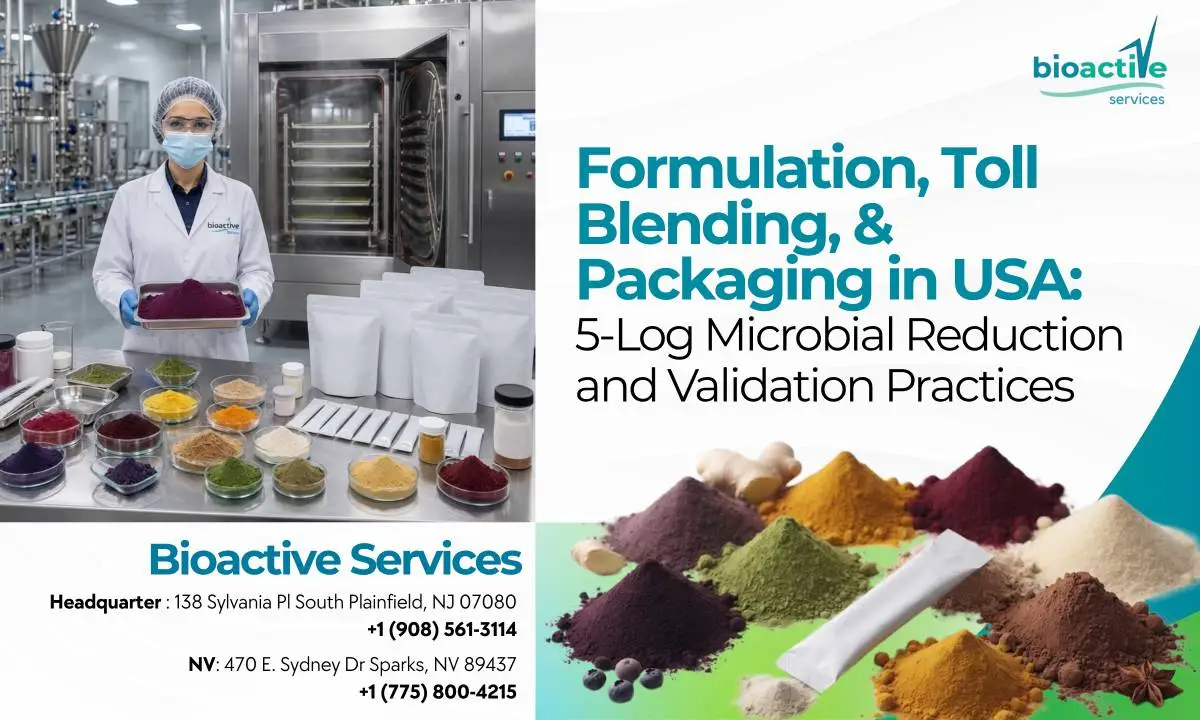
Formulation, Toll Blending, & Packaging in USA: 5-Log Microbial Reduction and Validation Practices
For manufacturers of powdered ingredients, food products, nutraceuticals, herbs, spices, and botanical formulations, product development involves much more than combining ingredients and selecting a package. Manufacturers must also consider microbial quality, process consistency, formulation stability, traceability, and the ability to scale production efficiently.
This is where Formulation, Toll Blending, & Packaging in USA can become an important part of an integrated manufacturing strategy. When microbial reduction is also required, manufacturers need to consider how processing conditions, formulation characteristics, blending, testing, validation, and packaging work together.
A 5-log microbial reduction represents a 99.999% reduction in a defined microbial population. However, achieving a 5-log reduction is not simply a matter of testing a finished product and reporting a result. The reduction target needs to be associated with a defined microorganism, product, process, and set of processing conditions.
For companies evaluating toll blending services in the USA, understanding the relationship between microbial reduction and validation can help them choose a processing partner capable of supporting quality, consistency, and commercialization.
What Is a 5-Log Microbial Reduction?
A 5-log microbial reduction describes a 99.999% reduction in a defined microbial population.
For example, if a product begins with a population of 100,000 microorganisms and a validated process achieves a 5-log reduction, the theoretical reduction would leave approximately one organism from that starting population.
The important point is that a 5-log reduction is a measurement of microbial reduction, not necessarily complete sterilization.
Understanding the 99.999% Reduction
The term “log reduction” describes the number of orders of magnitude by which a microbial population is reduced.
A simplified reference is:
- 1-log reduction = 90% reduction
- 2-log reduction = 99% reduction
- 3-log reduction = 99.9% reduction
- 4-log reduction = 99.99% reduction
- 5-log reduction = 99.999% reduction
The required reduction depends on the product, target organism, intended application, processing method, and applicable food-safety requirements.
5-Log Reduction vs. Complete Sterility
A validated 5-log reduction should not automatically be described as complete sterility.
Instead, it indicates that a defined process has demonstrated a specific level of microbial reduction against a defined target under specified conditions.
This distinction matters when manufacturers evaluate food sterilization service providers in the USA or third-party microbial reduction partners.
The terminology, validation approach, and process claims should accurately reflect what has been demonstrated.
Why the Target Must Be Product and Process Specific
Different powdered ingredients can respond differently to heat, moisture, steam, and processing conditions.
Factors that can influence microbial reduction and product quality include:
- Ingredient composition
- Moisture content
- Particle size
- Bulk density
- Initial microbial load
- Heat sensitivity
- Processing time
- Processing temperature
- Steam exposure
- Equipment configuration
Consequently, manufacturers should avoid assuming that a processing condition validated for one ingredient automatically applies to another.
Why Microbial Reduction Matters for Powdered Ingredients
Powdered ingredients can move through several stages before reaching a finished product. Agricultural materials may be harvested, dried, transported, stored, processed, blended, and packaged.
Each stage can affect microbial quality.
For this reason, microbial reduction can be an important component of a broader food-safety and quality strategy.
Herbs and Botanical Powders
Herbs and botanical ingredients originate from agricultural supply chains and can have naturally variable microbial loads.
Processing requirements can depend on the specific botanical material, its intended application, and the manufacturer’s specifications.
A carefully developed microbial-reduction process can help manufacturers address microbial concerns while considering the quality characteristics of the botanical.
Spices and Seasonings
Spices and seasoning powders are another category where microbial quality can be important.
Steam-based processing may be considered for applicable spice ingredients as part of a microbial-control strategy.
The processing objective should balance microbial reduction with preservation of desirable characteristics such as aroma, flavor, color, and functional performance.
Nutraceutical and Functional Powders
Nutraceutical formulations can contain multiple active ingredients, carriers, excipients, and functional components.
These materials may have different sensitivities to thermal and moisture exposure.
Consequently, microbial reduction should be considered alongside formulation stability and finished-product requirements.
Organic Powdered Ingredients
Organic ingredients may also require microbial-control strategies.
However, manufacturers should evaluate organic processing requirements separately from microbial-reduction objectives. An ingredient’s organic status does not automatically mean that every processing method or supply-chain practice is acceptable for a particular certified product.
Brands should confirm applicable organic requirements with their certification and quality teams.
How Formulation Affects Microbial Reduction
Formulation decisions can influence how a powdered product behaves during subsequent processing.
A formulation should therefore be evaluated not only for its final nutritional or functional objectives but also for its manufacturing characteristics.
Moisture, Particle Size, and Bulk Density
Powder properties can affect heat and moisture transfer during processing.
Important characteristics may include:
- Particle size distribution
- Bulk density
- Moisture content
- Flowability
- Ingredient concentration
- Powder structure
Understanding these properties can help manufacturers and processing partners develop appropriate process conditions.
Heat-Sensitive and Bioactive Ingredients
Some nutraceutical, botanical, and functional ingredients contain compounds that may be sensitive to heat or moisture.
Examples can include certain:
- Vitamins
- Enzymes
- Botanical compounds
- Aromatic components
- Flavors
- Functional ingredients
The objective is therefore not simply to maximize processing intensity. The process should be developed around the required microbial objective while considering the product’s quality characteristics.
Designing Formulations for Downstream Processing
Manufacturers can benefit from considering downstream manufacturing during formulation development.
Questions may include:
- Can the formulation be blended uniformly?
- How will the ingredients respond to processing?
- Will processing affect flow properties?
- Is the product sensitive to moisture?
- What packaging format is appropriate?
- How will the product be handled after microbial reduction?
Early consideration of these questions can reduce manufacturing challenges later in the development process.
Integrating 5-Log Reduction With Toll Blending Services in USA
Toll blending services in USA can provide a manufacturing pathway for companies that need powdered ingredients combined according to defined formulations and specifications.
When microbial reduction is part of the production strategy, the blending stage should be considered in relation to the overall process.
Controlled Batch Processing
Toll blending can help manufacturers manage multiple powdered ingredients within defined batch procedures.
Typical controls may involve:
- Ingredient identification
- Weighing
- Batch sequencing
- Equipment preparation
- Blend time
- Blend uniformity
- Lot tracking
- Batch documentation
The exact controls depend on the product and manufacturing system.
Blend Uniformity and Consistency
Uniform blending is essential when ingredients are included at different concentrations.
A properly controlled blending process can help reduce variability between production lots and support consistent finished-product specifications.
This becomes particularly important for nutraceutical and functional formulations containing multiple active ingredients.
Lot Traceability and Documentation
Traceability connects raw materials to finished products.
A well-organized workflow may establish a chain such as:
Raw ingredient lot → Processing lot → Blend batch → Packaging lot → Finished product
This information can be valuable for quality investigations, product release, inventory management, and customer documentation.
Reducing Manufacturing Handoffs
Using separate suppliers for formulation, microbial processing, blending, and packaging can create additional logistics and communication requirements.
An integrated toll processing partner can potentially reduce unnecessary handoffs and simplify coordination between manufacturing stages.
How Steam Processing Supports Microbial Reduction
Steam processing can provide a controlled heat-and-moisture approach for microbial reduction in applicable powdered ingredients.
The effectiveness of the process depends on the product and the conditions under which it is processed.
Controlled Heat and Steam Exposure
Process conditions may include variables such as:
- Temperature
- Time
- Steam exposure
- Product characteristics
- Processing load
- Equipment configuration
These variables should be established and controlled according to the process design and validation requirements.
Balancing Microbial Reduction With Product Quality
A stronger microbial-reduction process is not automatically a better process if it unnecessarily compromises product quality.
Manufacturers may need to consider the effects of processing on:
- Color
- Aroma
- Flavor
- Nutritional characteristics
- Bioactive compounds
- Solubility
- Flow properties
- Functional performance
The goal is to establish processing conditions that address the defined microbial objective while maintaining acceptable product characteristics.
Process Development Before Validation
Validation should follow appropriate process development.
Before conducting validation, manufacturers and processing partners may need to determine:
- The product’s relevant characteristics
- The microbial-reduction objective
- Appropriate processing parameters
- Critical process variables
- Sampling requirements
- Analytical methods
- Acceptance criteria
Once the process has been appropriately developed, validation can provide evidence that the process performs as intended under defined conditions.
5-Log Microbial Reduction Validation Practices
Validation is central to demonstrating that a microbial-reduction process is capable of meeting a defined objective.
It should be based on the actual product and processing conditions rather than a generalized claim.
Define the Validation Objective
A validation program should begin with a clear objective.
This may identify:
- Target microorganism
- Desired reduction level
- Product
- Processing method
- Processing conditions
- Testing methodology
- Acceptance criteria
A clearly defined objective provides a foundation for the validation study.
Identify Critical Process Parameters
The process should identify the variables that are important to achieving the intended result.
Depending on the technology and product, these may include:
- Time
- Temperature
- Steam exposure
- Product temperature
- Moisture interaction
- Processing load
Monitoring the appropriate parameters helps establish process consistency.
Establish Baseline and Post-Process Microbial Levels
Microbiological testing can help characterize the microbial population before and after processing.
A validation approach may evaluate:
Pre-process microbial level → Defined treatment → Post-process microbial level
The results can then be evaluated against the established microbial-reduction objective.
Conduct Appropriate Microbiological Testing
Testing should use appropriate analytical methods and sampling procedures for the validation objective.
Testing may be used to evaluate:
- Baseline microbial levels
- Post-processing microbial levels
- Specific target organisms
- Process repeatability
- Finished-product specifications
Importantly, laboratory testing and process validation serve related but different purposes. Testing a finished lot does not by itself establish that the underlying process will consistently achieve a specific reduction under all conditions.
Document Validation and Ongoing Verification
Validation documentation can include:
- Product identification
- Processing parameters
- Test results
- Sampling plans
- Equipment information
- Batch records
- Deviations
- Corrective actions
- Validation reports
After validation, ongoing verification can help confirm that the process continues to operate within established parameters.
Packaging After Microbial Reduction
Packaging is an important part of the manufacturing workflow because product safety does not end when microbial reduction processing is completed.
Post-process handling should be designed to minimize opportunities for contamination or loss of product integrity.
Preventing Post-Process Recontamination
Manufacturers should consider how processed material moves from the processing stage into blending, holding, filling, and packaging.
Appropriate handling controls can help protect the processed product.
Hygienic Product Transfer
The transfer of processed powder between equipment and packaging systems should be managed according to the applicable quality and sanitation procedures.
The objective is to maintain product integrity throughout the remaining manufacturing steps.
Packaging Integrity and Lot Coding
Packaging should protect the product during storage and distribution.
Depending on the application, considerations may include:
- Package material
- Moisture protection
- Seal integrity
- Product compatibility
- Lot coding
- Storage conditions
Clear lot identification also supports traceability.
Traceability From Raw Material to Finished Product
An integrated system can connect the original ingredient lots to processing, blending, and packaging records.
This creates a clearer manufacturing history and can simplify quality documentation.
What to Look for in a U.S. Processing Partner
Selecting a toll processor requires more than comparing price and production capacity.
Manufacturers should evaluate whether the provider’s capabilities align with the technical and commercial requirements of the project.
Formulation Expertise
A capable partner should understand how ingredient characteristics affect processing, blending, and finished-product performance.
For custom products, formulation support can also help manufacturers transition from concept development to repeatable production.
Toll Blending Capabilities
Evaluate whether the provider can manage:
- Powder blending
- Multiple ingredients
- Batch consistency
- Lot traceability
- Production documentation
- Scale-up
The equipment and process should be appropriate for the product and expected production volume.
Microbial Reduction and Validation Experience
Ask prospective partners about:
- Microbial-reduction capabilities
- Validation methodology
- Target organisms
- Process parameters
- Testing
- Documentation
- Ongoing verification
Manufacturers should understand exactly what a provider’s microbial-reduction claims represent.
Packaging Capabilities
If packaging is required, consider whether the partner can provide the appropriate packaging format and post-processing controls.
Integrated packaging can reduce the number of external suppliers involved in the manufacturing chain.
Quality Documentation and Scalability
The right partner should be capable of supporting both quality requirements and commercial growth.
Consider:
- Batch documentation
- Traceability
- Testing records
- Production capacity
- Lead times
- Packaging formats
- Scale-up capabilities
Why Integrated Formulation, Toll Blending, & Packaging Can Improve Manufacturing
An integrated approach can provide advantages throughout the product-development and commercialization process.
Fewer Supplier Handoffs
Fewer handoffs can simplify communication and logistics.
Instead of coordinating separate companies for formulation, microbial reduction, blending, and packaging, manufacturers may be able to consolidate multiple stages with one processing partner.
Better Process Coordination
When formulation and downstream processing are considered together, manufacturers can address potential processing challenges earlier.
This can support a smoother transition from development to production.
Consistent Specifications
Integrated manufacturing allows product specifications to be communicated across the workflow.
This can help align formulation, processing, blending, testing, and packaging requirements.
Simplified Documentation
Coordinating multiple manufacturing stages through one provider can potentially simplify documentation and traceability.
This can become increasingly valuable as production volumes and product portfolios grow.
Which Companies Benefit From Toll Blending and Microbial Reduction Support?
A broad range of companies can benefit from integrated powdered ingredient processing.
These may include:
- Nutraceutical brands
- Dietary supplement manufacturers
- Food and beverage companies
- Spice companies
- Botanical ingredient suppliers
- Functional food brands
- Private-label manufacturers
- Emerging clean-label brands
For smaller or growing companies, outsourcing formulation, toll blending, microbial reduction, and packaging can provide access to specialized manufacturing capabilities without requiring the company to build every process internally.
Why Choose Bioactive Services for Powdered Ingredient Processing?
Finding a manufacturing partner that can coordinate multiple stages of powdered product development can simplify the path from raw ingredients to a finished commercial product.
Bioactive Services is positioned around the processing needs of powdered ingredients, blends, and formulations, providing a potential resource for companies seeking coordinated manufacturing support.
An integrated approach can connect:
Formulation → Processing → Toll Blending → Quality Control → Packaging
For projects involving microbial reduction, manufacturers should discuss the specific product, microbial objectives, processing requirements, testing strategy, and validation expectations with their processing partner.
The goal is to develop a process that is appropriate for the actual product rather than relying on broad or unsupported microbial-reduction claims.
Frequently Asked Questions About 5-Log Microbial Reduction
What is a 5-log microbial reduction?
A 5-log microbial reduction represents a 99.999% reduction in a defined microbial population. The reduction should be associated with a specified microorganism, product, process, and processing conditions.
Is a 5-log reduction the same as sterilization?
No. A 5-log reduction describes the magnitude of reduction against a defined microbial target. It should not automatically be interpreted as complete sterility or elimination of every microorganism.
How is a 5-log reduction validated?
A validation program generally defines the target microorganism and reduction objective, establishes appropriate process parameters, conducts microbiological testing, and documents evidence that the process achieves the intended reduction under the specified conditions.
Why does formulation matter for microbial reduction?
Formulation characteristics such as moisture, particle size, bulk density, ingredient composition, and heat sensitivity can influence processing behavior. Considering formulation and microbial reduction together can help manufacturers develop a more appropriate processing strategy.
Can toll blending and packaging be integrated with microbial reduction?
Yes. Depending on the capabilities of the processing partner, formulation, microbial-reduction processing, toll blending, quality controls, and packaging can be coordinated as connected stages of production.
What powdered ingredients may require microbial reduction?
Herbs, spices, botanicals, nutraceutical ingredients, and functional food powders may require microbial-control strategies depending on their characteristics, specifications, intended application, and applicable requirements.
What should manufacturers ask a microbial-reduction processing partner?
Manufacturers should ask about the processing method, target microorganisms, validation methodology, critical process parameters, testing procedures, documentation, traceability, packaging controls, and scalability.
Conclusion: Integrating 5-Log Validation Into Powder Processing
For powdered ingredient manufacturers, microbial reduction should be considered as part of the overall manufacturing strategy rather than as an isolated final step.
The relationship between formulation, microbial reduction, toll blending, validation, and packaging can influence both product quality and manufacturing consistency. A well-designed process considers the characteristics of the formulation, establishes appropriate processing parameters, uses suitable testing, documents validation, and maintains appropriate controls through packaging.
For companies searching for Formulation, Toll Blending, & Packaging in USA, selecting an experienced processing partner can help simplify manufacturing while providing a more coordinated path from raw ingredients to finished products.
When a 5-log microbial reduction is required, manufacturers should focus on product-specific process development, appropriate validation, microbiological testing, documentation, and ongoing verification rather than relying on generic claims.
Bioactive Services can help companies explore integrated solutions for powdered ingredients, custom formulations, toll blending, microbial-reduction processing, and packaging.
Ready to discuss your next powdered ingredient or formulation project? Visit Bioactive Services to learn more about available processing and manufacturing solutions.